
Biomedical engineering is one of the fastest-growing technological disciplines worldwide. Its primary objective is to apply engineering principles to healthcare in order to improve diagnosis, treatment, rehabilitation, and patients’ overall quality of life.
By integrating knowledge from fields such as mechanical engineering, electronics, computer science, materials science, and health sciences, biomedical engineering has driven the development of technologies that are now essential in hospitals, research centers, and laboratories around the world.
Biomedical engineering combines scientific and technological expertise to design systems capable of addressing today’s healthcare challenges. Its applications range from the development of medical devices to patient monitoring, tissue engineering, advanced rehabilitation, clinical process automation, and the design of electronic systems for biomedical signal acquisition and processing.
In recent years, advances in technologies such as artificial intelligence, robotics, biomaterials, and smart systems have enabled a new generation of medical devices capable of delivering more accurate diagnoses and increasingly personalized treatments. Neuromuscular signal-controlled prostheses, robotic assistance systems, remote patient monitoring technologies, and intelligent rehabilitation devices are just a few examples of the innovations transforming modern medicine.
These advances require professionals with a strong technical background and a comprehensive understanding of the mechanical, electronic, and biomedical principles that underpin these technologies. The convergence of biomechanics, applied electronics, and biomedical equipment enables the development of increasingly sophisticated solutions for diagnosis, treatment, and rehabilitation, establishing biomedical engineering as a fundamental discipline for the future of healthcare.
In this context, hands-on education and access to specialized equipment are essential. At EDIBON, we actively support this objective by providing equipment designed for universities, technology centers, and research institutions, promoting applied learning and the development of advanced technical skills.
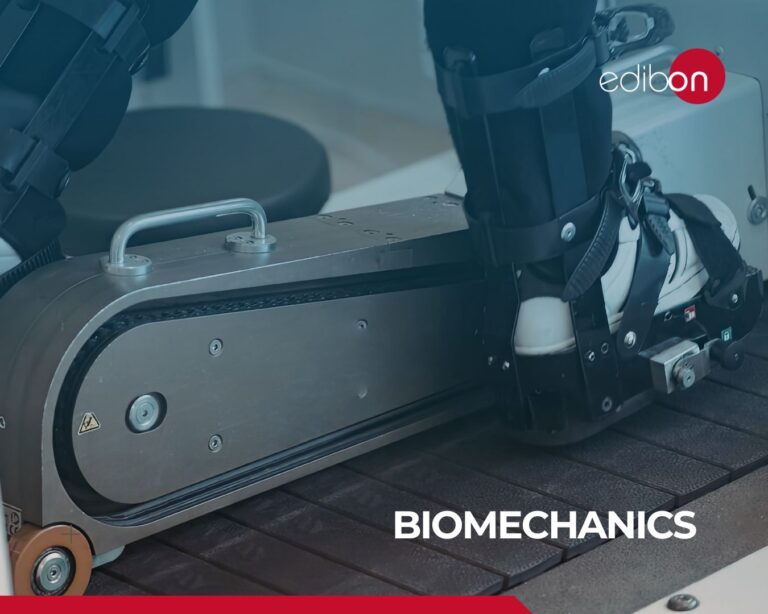
Biomechanics: Understanding the mechanical behavior of the human body
Biomechanics is one of the core disciplines within biomedical engineering. It focuses on the mechanical behavior of living organisms by applying principles of mechanics, anatomy, and physiology.
In the case of the human body, biomechanics analyzes how forces interact with muscles, bones, tendons, and joints, as well as how the body responds under different loading and movement conditions.
This knowledge is essential for the development of solutions such as:
- Advanced prosthetics and orthotics.
- Biomedical implants.
- Rehabilitation systems.
- Exoskeletons and medical robotics.
- Human motion analysis.
- Prevention of sports- and clinically-related injuries.
In addition, biomechanics contributes to the study of biological tissues and organs, supporting the development of innovative medical technologies and improving clinical procedures.
Applied electronics in Biomedical Engineering: Technology serving healthcare
Applied electronics is another fundamental area within biomedical engineering. Its purpose is to design, develop, and optimize electronic devices capable of measuring, monitoring, and processing biological signals for medical and research applications.
Biomedical electronics makes it possible to develop equipment used daily in hospitals, laboratories, and research centers, including patient monitoring systems, biomedical signal acquisition devices, and specialized medical instrumentation.
Its main applications include:
- Physiological parameter monitoring.
- Biomedical signal acquisition and processing.
- Medical instrumentation development.
- Electronic systems for clinical diagnosis.
- Remote monitoring and telemedicine devices.
- Integration of sensors and smart healthcare systems.
Advances in electronics, component miniaturization, and intelligent system integration are driving a new generation of medical devices that are increasingly accurate, connected, and tailored to patients’ needs.
Biomedical Equipment: The foundation of education and applied research
Biomedical equipment encompasses the devices, instruments, and systems designed for studying, simulating, measuring, and analyzing the physiological processes of the human body, as well as for developing and evaluating healthcare technologies. These systems represent an essential resource for both professional education and medical research and development.
Biomedical equipment includes a wide variety of technologies dedicated to studying different physiological systems and healthcare applications. Among the most important are systems for physiological signal analysis, such as electrocardiography (ECG), electromyography (EMG), and electroencephalography (EEG); respiratory system analysis equipment, including spirometry and pulmonary function testing systems; equipment for cardiovascular analysis and monitoring, including blood pressure, blood flow, and cardiac activity monitoring; as well as technologies related to electrotherapy, bioinstrumentation, biomedical data acquisition, patient simulation, and vital signs monitoring.
In addition, biomedical equipment includes systems for studying biomechanics, rehabilitation, medical instrumentation, clinical engineering, biomaterials, and diagnostic technologies, enabling students and researchers to understand the operation of medical devices and evaluate their performance under controlled conditions.
EDIBON's contribution to Biomedical Engineering education
At EDIBON, we contribute to the development of competencies in biomechanics, applied electronics, and biomedical equipment through a comprehensive portfolio of systems designed for hands-on education and applied research.
Our equipment enables students and researchers to study mechanical phenomena, biomedical signals, electronic instrumentation principles, and the behavior of various systems used in healthcare and research applications.
Using these training systems, learners can analyze physical and biological variables, understand the operation of biomedical devices, and develop technical skills aligned with the current demands of the healthcare sector.
Furthermore, our extensive range of equipment and accessories allows laboratories to be adapted to different educational levels, research programs, and areas of specialization, supporting multidisciplinary education that meets the evolving needs of biomedical engineering.
Practical education for healthcare innovation
Biomedical engineering requires professionals capable of integrating expertise in mechanical engineering, electronics, materials science, and health sciences. Consequently, practical education is essential for transforming theoretical knowledge into real technological solutions.
Our educational approach, based on experimentation and applied learning, enables students to acquire the technical competencies required to address the challenges associated with developing future medical devices, rehabilitation systems, and biomedical technologies.
Biomedical engineering is a key discipline in the development of technologies that improve healthcare and enhance people’s quality of life. Within this field, disciplines such as biomechanics, applied electronics, and biomedical equipment work together to drive medical and scientific innovation.
Practical training and access to specialized equipment are essential for preparing the professionals who will lead the future of this rapidly evolving sector. Through our Biomedical Engineering equipment, EDIBON supports the education of students and researchers by providing equipment that bridge the gap between theory and practice while fostering the development of next-generation biomedical technologies.