
How does a wind farm actually work? What happens when wind speed changes? How does blade angle affect the performance of a wind turbine? And what happens when operating conditions are not ideal?
Answering these questions solely from a theoretical perspective can be challenging. Wind energy system emulation makes it possible to recreate different scenarios, modify parameters, and analyze their effects without the need to directly intervene in an industrial installation.
In technical education and training, combining simulation with hands-on experimentation provides a particularly powerful equipment. It allows students to move from understanding the principles of wind energy to experimenting with them and, ultimately, relating them to the operation of real wind turbines.
Why is wind energy emulation important?
Wind energy depends on multiple variables. Wind speed and direction, rotor characteristics, blade angle, rotational speed, and load conditions directly affect the amount of energy a wind turbine can generate.
Recreating all these conditions in a real installation is not always feasible in an educational environment. Simulation, however, makes it possible to modify different parameters and observe how the system responds in a controlled environment.
In addition, mathematical models can represent the relationships between the different components of a wind power plant and allow students to analyze scenarios that would be difficult or costly to reproduce physically.
In this way, emulation becomes a bridge between theoretical concepts and the operation of real-world energy systems.
Wind Power Plant Simulation: Understanding the complete system
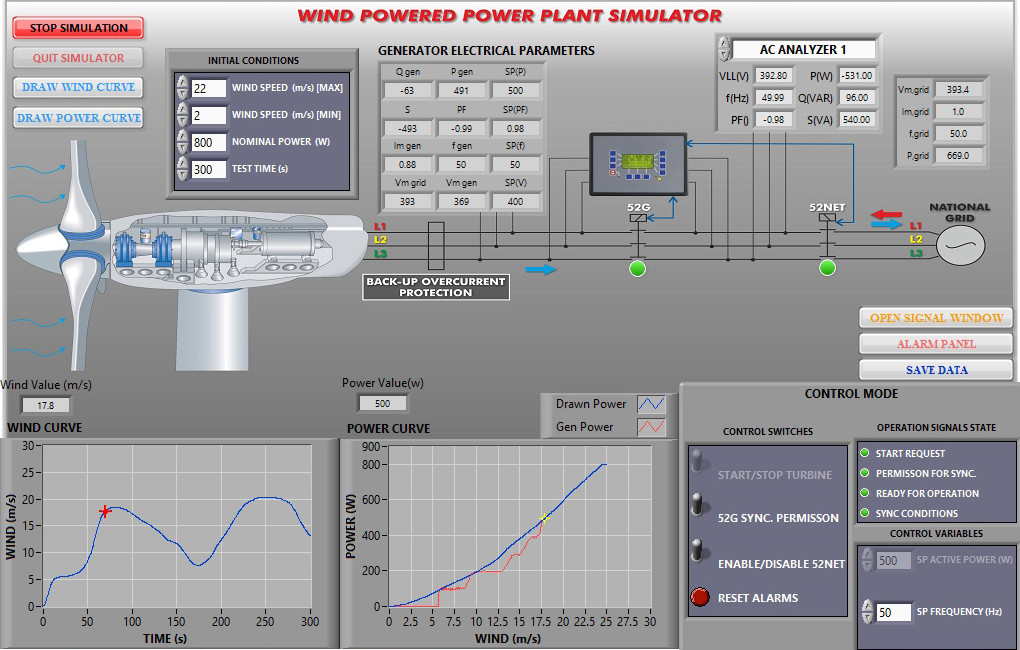
An example of this approach is EDIBON’s Wind Powered Power Plant Simulator (PSV-WPPP-SOF).
This software has been designed to demonstrate the basic operating principles of wind power generation plants through mathematical models representing the different components and parameters involved in the process.
The simulator allows different operating conditions to be configured in advance and then analyzed to determine how they affect plant performance. In this way, students can study the interaction between variables and understand the principles of control, operation, and management of a wind power plant.
The model also represents typical wind turbine components, such as the turbine, shaft, gearbox, and generator, helping students understand how the kinetic energy of the wind is converted into electricity.
From the virtual model to hands-on experimentation
Emulation becomes even more powerful when combined with laboratory equipment.
Rather than simply observing how a model behaves, students can conduct hands-on experiments with a small-scale wind turbine and determine how the variables studied actually affect its performance.
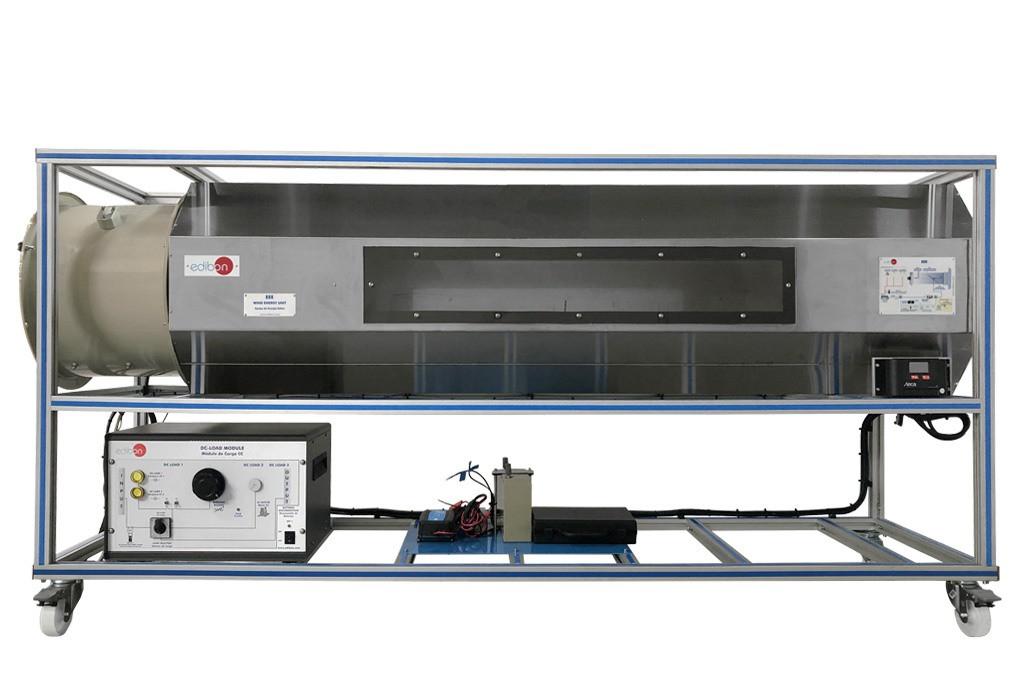
EDIBON’s Wind Energy Unit (EEE) incorporates a laboratory-scale wind turbine, a tunnel, and a variable-speed axial fan. The system allows users to modify both the angle of incidence and the blade angle and study how these variables affect electricity generation.
Experiments can include studying the power generated as a function of wind speed, determining the air velocity-power curve, analyzing the influence of the angle of incidence, and studying the power coefficient.
This makes it possible to transform concepts that may initially seem abstract into variables that students can directly modify, measure, and analyze.
When data comes into play: Computer-Controlled Wind Energy
Digitalization adds a new dimension to hands-on experimentation.
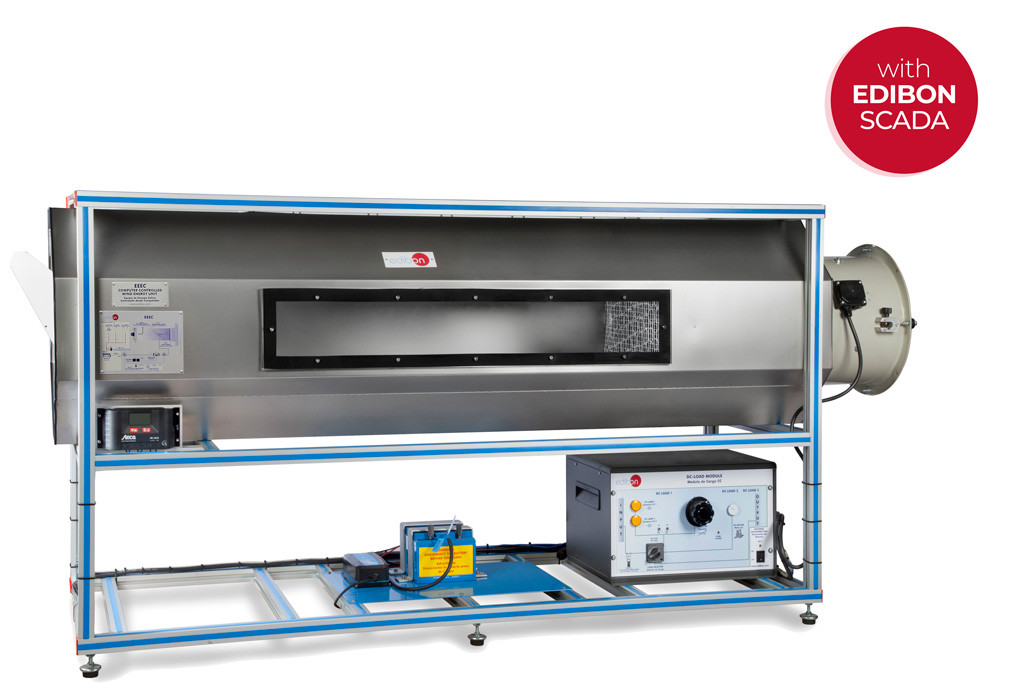
EDIBON’s Computer Controlled Wind Energy Unit (EEEC) integrates a laboratory-scale wind turbine with a control and data acquisition system based on EDIBON’s SCADA system. The equipment allows users to measure variables such as air temperature, air velocity, rotor speed, voltage, and current in real time.
This enables students not only to conduct the experiment but also to collect and analyze data digitally.
For example, they can study how generated power changes when wind speed is modified, analyze different blade configurations, or determine characteristic parameters of the wind turbine.
Experimentation thus becomes a complete process: configuring, measuring, visualizing, analyzing, and drawing conclusions.
Training that connects the classroom with industry
The true potential of emulation lies not in replacing experimentation, but in complementing it.
A comprehensive training strategy can begin with the emulation of a wind power plant to understand the overall behavior of the system. Students can then work with a small-scale wind turbine to physically observe energy conversion. Finally, control and data acquisition systems allow them to conduct deeper analyses and bring the experience closer to digitalized industrial environments.
This combination enables students to develop technical knowledge while also building skills related to data interpretation, process control, energy efficiency, and problem-solving.
EDIBON: Emulation and experimentation for Wind Energy Training
Training in renewable energy requires a combination of theoretical knowledge, hands-on experimentation, and digital technology.
For this reason, EDIBON offers a range of equipment for studying wind energy from different perspectives, from basic small-scale equipment to computer-controlled systems and emulation equipment for complete wind power plants.
Because preparing the professionals who will contribute to the energy transition requires more than explaining how a wind turbine works. They need the equipment to experiment with it, analyze its behavior, and understand how to optimize its performance.
Her profile combines the analytical and structured mindset of engineering with a practical focus on product development, process optimization, and cross-functional coordination. She works with clear criteria of quality, usability, consistency, and reliability, ensuring that products are technically sound and aligned with both business and user needs.
Throughout her career, she has contributed to initiatives related to product and process improvement, digital solutions, and structured project management, participating in the definition, coordination, and continuous evolution of products and services. She brings an analytical vision together with attention to detail, clarity, and coherence, allowing her to adapt products to different contexts, markets, and brand requirements.
Interested in innovation, digital evolution, and best practices in product development, she approaches her work from a practical, well-documented perspective focused on continuous improvement and the creation of useful, reliable, and high-quality products for end users.
- From the classroom to the wind turbine: the power of simulation in wind energy - Setembro 30, 2026
- Can CO₂ be turned into money? The CCUS technologies making it possible - Setembro 30, 2026
- How Industrial Automation Is Reducing Costs in the Food Industry
- Setembro 30, 2026