Did you know that nearly half of the energy consumption in a building or residential property is dedicated exclusively to heating, cooling, and domestic hot water production? In a global context driven by the energy transition and the need to reduce CO₂ emissions, efficient technologies are no longer an option, they are a necessity.
Among the most promising solutions for achieving these objectives are heat pumps, a technology that has become one of the cornerstones of building and facility decarbonization. Their high energy efficiency and ability to utilize renewable energy sources available in the environment position them among the most advanced alternatives for sustainable climate control.
But how do heat pumps actually work, and why are they considered a key technology for the future of energy? Let’s take a closer look.
The “Secret”: How Does a Heat Pump Work?
Para comprender el potencial de ahorro de una bomba de calor es importante entender su principio de funcionamiento.
To understand the energy-saving potential of a heat pump, it is important to first understand its operating principle.Unlike a gas boiler or a conventional electric resistance heater, which generate heat directly through fuel combustion or electricity consumption, a heat pump uses the principles of thermodynamics to transfer thermal energy. Its function is to capture heat present in the natural environment (outdoor air, water, or the ground) and transfer it into the building.
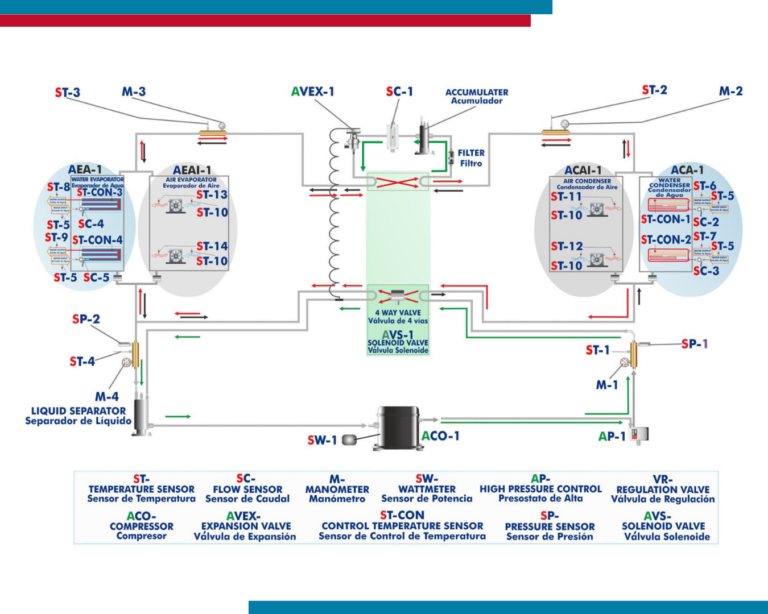
Its operation is based on a refrigeration cycle consisting of four stages:
- Heat Absorption: A low-temperature refrigerant circulates through a heat exchanger (evaporator) and absorbs heat from the surrounding environment, even when outdoor temperatures are low.
- Compression: An electric compressor increases the refrigerant pressure, significantly raising its temperature.
- Heat Transfer: The hot refrigerant passes through a second heat exchanger (condenser) and transfers its thermal energy to the heating system or domestic hot water circuit.
- Expansion: The refrigerant passes through an expansion valve, where its pressure and temperature decrease sharply, preparing it to restart the cycle.
One of the major advantages of this technology is that many systems are reversible. This means that, in addition to providing heating during winter, they can also operate as cooling systems during summer using the same operating principle.
Why Are Heat Pumps a Key Technology?
The growing adoption of heat pumps worldwide is no coincidence. Their energy and environmental performance make them one of the most efficient technologies currently available.
- High energy efficiency (the source of savings): Heat pumps can achieve Coefficients of Performance (COP) ranging from 3 to 5 under favorable operating conditions. This means that for every 1 kWh of electricity consumed, they can deliver between 3 and 5 kWh of thermal energy to the building, significantly reducing energy consumption compared to conventional systems.
- Sustainability and emissions reduction: Heat pumps utilize renewable energy available in the air, water, or ground, reducing dependence on fossil fuels and helping lower CO₂ emissions, particularly when powered by electricity generated from renewable sources.
- Integrated Services: Many modern heat pump systems can provide heating, cooling, and Domestic Hot Water (DHW) through a single installation, simplifying the building’s energy management.
- Reduced Maintenance: Because there is no combustion process or exhaust gas production, heat pumps generally require less maintenance than conventional boilers while offering high levels of safety and long service life.
- Perfect synergy with photovoltaic energy:When combined with solar panels, a heat pump can operate largely using self-generated solar electricity. The result is a substantial reduction in both energy costs and emissions associated with climate control and domestic hot water production.
The Big Challenge: Training the Engineers of Tomorrow
The theory behind heat pumps is remarkable, but their implementation in smart buildings, industrial facilities, and advanced energy systems requires highly qualified professionals.
The energy transition demands not only more efficient technologies but also engineers and technicians capable of designing, operating, and optimizing them. For this reason, it is essential to have training equipment that allows students and researchers to study, in a practical way, the thermodynamic principles and real processes involved in these systems.
In this context, EDIBON plays a key role as an international supplier of educational equipment for thermal engineering, providing solutions that enable students, educators, and researchers to work with technologies currently used in industry.
THIBAR44C: A Flagship in Thermal Engineering Education
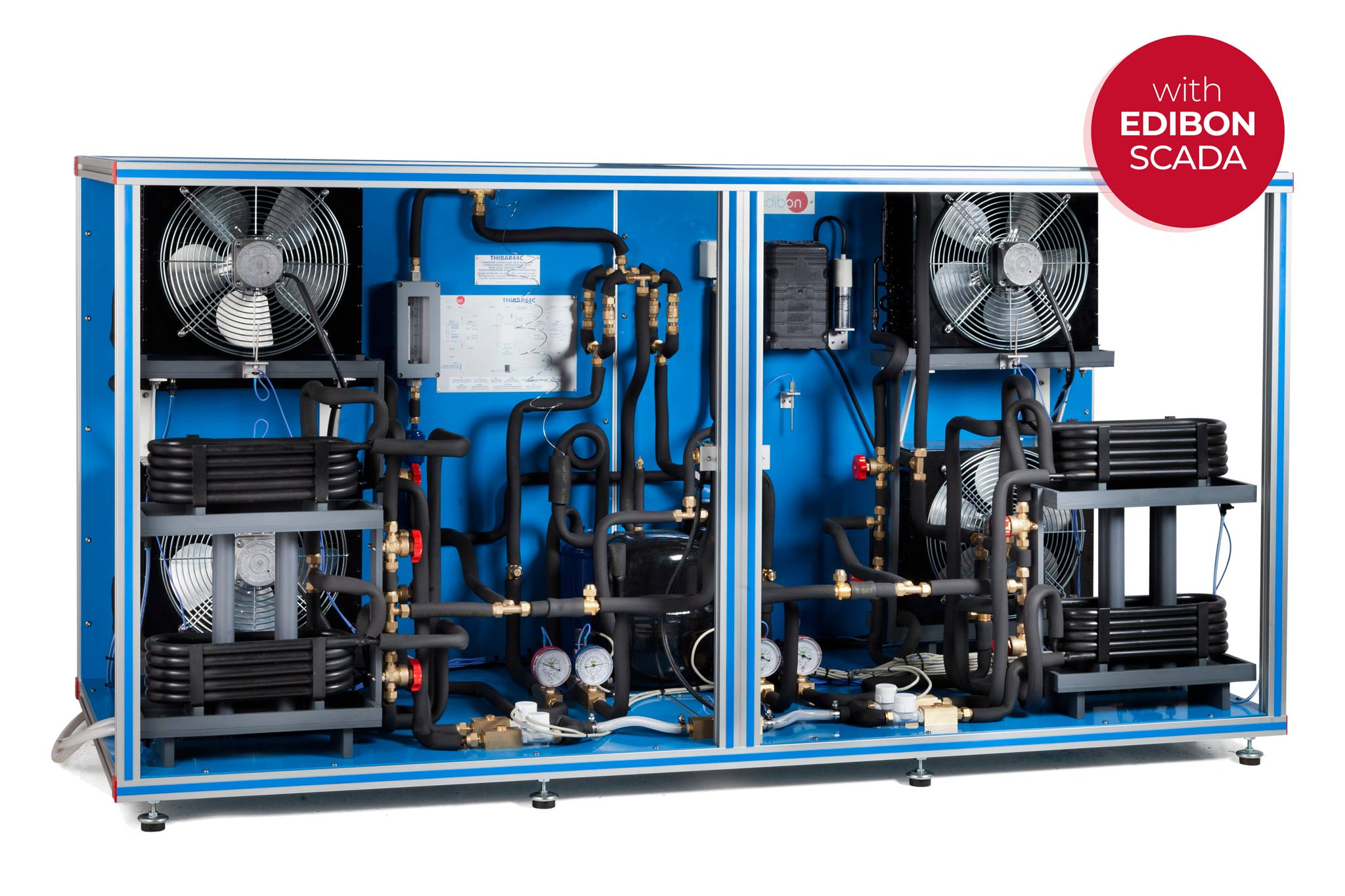
Computer-Controlled Reversible Heat Pump, Air Conditioning & Refrigeration System (THIBAR44C)
One of EDIBON’s most advanced systems in this field is the Computer Controlled Rerversible Heat Pump + Air Conditioning + Refrigeration with 4 Condensers and 4 Evaporators (Water/Air) (THIBAR44C)
This unit represents a comprehensive solution for the study of modern HVAC systems, standing out for its:
Experimental Versatility: It allows operation with multiple condenser and evaporator configurations, enabling comparative analysis under different operating conditions.
Advanced Control: The system is fully computer-controlled, allowing real-time monitoring of key variables such as temperature, pressure, flow rate, and performance.
Comprehensive Educational: Approach Students can analyze:
- Refrigeration and heat pump cycles
- Coefficient of Performance (COP)
- Heat exchange in air and water
- System energy efficiency
Practical Application: It simulates real HVAC operating conditions, preparing students for industrial and professional environments.
Thanks to its computerized control system, it is possible to accurately visualize and analyze the system’s behavior, making it easier to understand the thermodynamic phenomena involved.
THIBARR22C: A Versatile Solution for Studying Refrigeration Systems and Heat Pumps
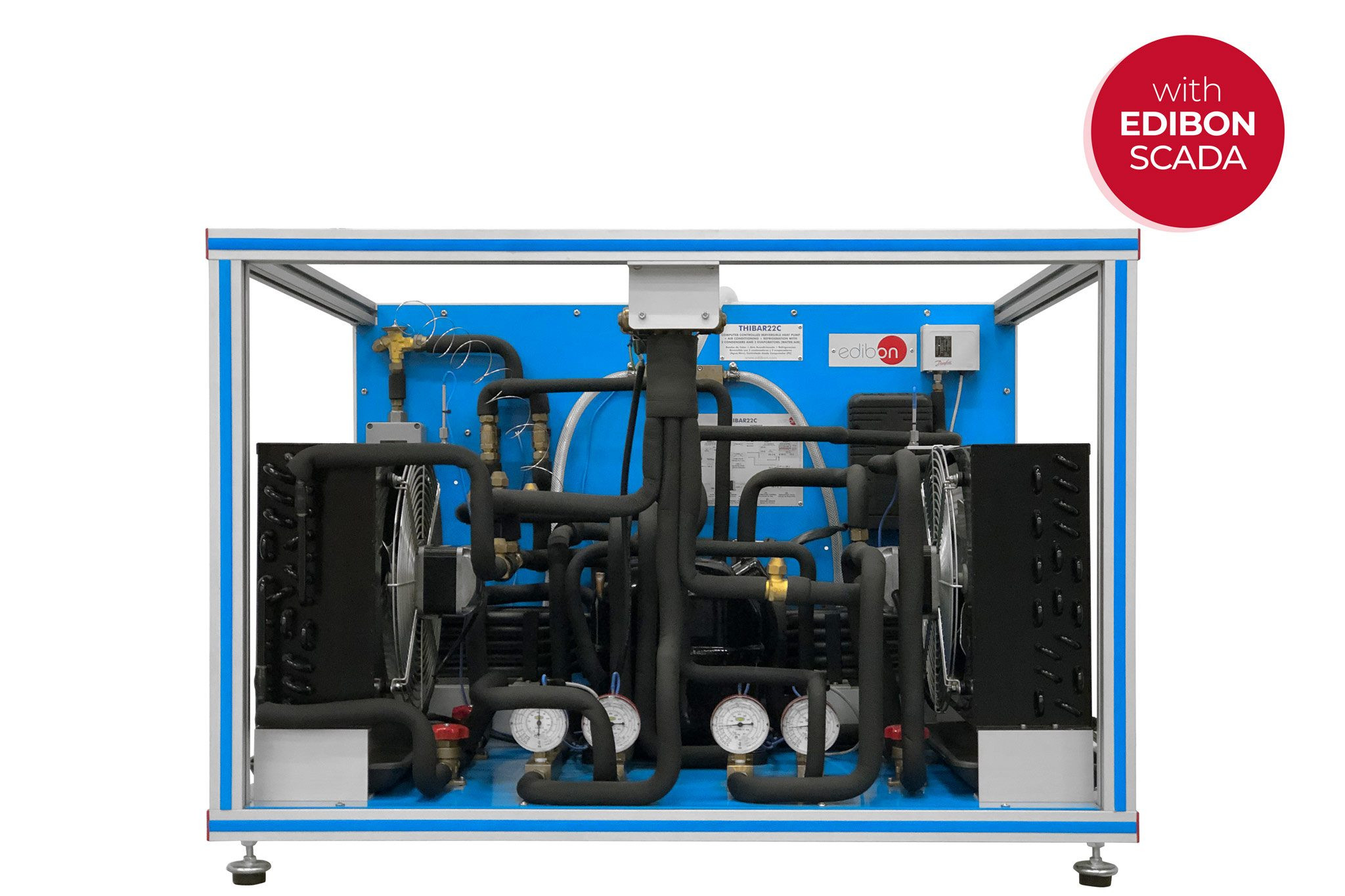
Another outstanding EDIBON solution in this field is the Computer Controlled Reversible Heat Pump and Refrigeration Unit (THIBARR22C).
This unit enables practical study of vapor-compression refrigeration systems and reversible heat pumps, providing a comprehensive understanding of the principles behind these technologies.
With the THIBARR22C, users can perform experiments related to:
- Complete analysis of the vapor-compression refrigeration cycle
- Study of reversible heat pump operation
- Experimental determination of the Coefficient of Performance (COP)
- Evaluation of energy balances
- Monitoring of temperatures, pressures, and flow rates
- Comparison of system behavior under different operating conditions
Its educational design and data acquisition system make it possible to clearly understand how energy-efficient climate control technologies operate
Conclusion
Heat pumps have become one of the most important technologies for advancing toward a more efficient and sustainable energy model. Their ability to harness energy available in the environment and transform it into heating, cooling, or domestic hot water with high levels of efficiency places them at the center of the energy transition.
However, the success of this transformation also depends on educating the professionals who will design, operate, and optimize these systems in the future.
Through units such as the THIBAR44C and THIBARR22C, EDIBON contributes to the practical training of students, educators, and researchers by providing advanced tools for gaining an in-depth understanding of the thermal technologies that will shape the future of sustainable energy.
If you want to prepare the professionals of tomorrow to meet the challenges of energy efficiency and sustainable climate control, EDIBON’s solutions provide a learning experience based on real technology, innovation, and practical application.